If you spend enough time around guitar forums, you eventually start to believe there are only two pickup food groups: the glassy, scooped chime of a Fender-style single coil and the thick, compressed roar of a dual-coil humbucker. Everything else gets treated like an exotic side dish.
Then you plug into a guitar loaded with P-90s, turn an amp up past the point of polite conversation, and realize you have been missing the best middle ground in electric guitar history.
Introduced by Gibson in 1946, the P-90 is the bridge between worlds—a wide, flat, muscular single-coil pickup that hits the front end of an amplifier with far more midrange bark and output than a Stratocaster or Telecaster pickup, yet retains the raw string separation, pick sensitivity, and top-end snarl that humbuckers inevitably smooth away. It is the sound of early electric blues, 1950s jazz archtops, Pete Townshend windmilling through Hiwatt stacks, Leslie West shaking the rafters at Woodstock, Johnny Thunders tearing up New York clubs, and Billie Joe Armstrong driving arena-sized punk hooks.
Even more remarkably, the P-90 is one of the oldest surviving pieces of electric guitar hardware still in continuous, unaltered demand eighty years after it left Kalamazoo. While Seth Lover’s PAF humbucker tends to soak up most of the collector mythology, it was Gibson electronics chief Walt Fuller who cracked the code first.
Pull up a stool, grab a pint, and let’s trace the complete history of the P-90—from heavy pre-war cobalt bars and wartime electronics contracts to soapbars, dog-ears, Alnico magnet swaps, and modern Drop D riffing.
Before the P-90: Cobalt Bars, Diagonal Experiments and the P-13
To understand why the P-90 felt like such a revelation in 1946, you have to look at the clunky, heavy-handed pickups that came before it.
Gibson’s serious entry into the electric Spanish guitar market began in 1936 with the ES-150—the instrument forever linked with jazz pioneer Charlie Christian. The pickup inside the ES-150, retrospectively dubbed the “Charlie Christian” pickup, sounded glorious: warm, vocal, and authoritative enough to let a guitar cut through a swinging big band for the first time. From a manufacturing and practical standpoint, however, it was a beast. Built around massive, heavy cobalt steel bar magnets mounted underneath the guitar’s top, the assembly weighed roughly two pounds. It required substantial routing, stressed carved spruce tops, and demanded expensive, bulky materials.
By 1940, newly developed Alnico (aluminium-nickel-cobalt) magnets offered a way to get strong magnetic fields in a much smaller, lighter package. Gibson’s engineering team—led by Walt Fuller, who had joined the company in 1933 and headed up its electronics department—began experimenting with lighter, surface-mountable designs.
Their first major attempt in 1940 was an unusual “offset adjustable” pickup installed diagonally from the neck toward the bridge, which soon evolved into a shorter diagonal unit. Alongside it, Fuller developed the P-13 in 1940. Compact, rectangular, and housing an Alnico magnet, the P-13 looked closer to a modern mini-humbucker than a P-90. It delivered a dark, throaty, mid-focused voice that still has a cult following among vintage blues players and fans of old Harmony and Silvertone guitars (where surplus and licensed versions later turned up). Yet neither the diagonal pickup nor the P-13 had the clarity, balance, and string-to-string adjustability Gibson wanted for its flagship postwar catalog.
Then came World War II. Like every major American instrument maker, Gibson pivoted its Kalamazoo factory toward military production. While woodworking shops turned out glider skids and rifle stocks, Walt Fuller spent the war years supervising Gibson’s military electrical assembly subcontracts. Those four years of precision coil-winding, tight tolerances, and industrial electrical work directly shaped what happened the moment peacetime production resumed.

1946: Walt Fuller Designs a Classic
When Gibson reopened its civilian guitar lines at the end of 1945, Fuller didn’t go back to pre-war compromises. Combining lessons from the shorter diagonal pickup and the compact P-13, he unveiled a brand-new single-coil pickup in 1946: the P-90.
Why “P-90”? Gibson’s internal part-numbering system in the 1940s wasn’t overly romantic—just as the P-13 took its number from its catalog/part designation, the P-90 was simply the next major pickup unit assigned in Gibson’s engineering ledger. What mattered wasn’t the name; it was the architecture underneath the cover.
Fuller’s design was deceptively simple, yet mechanically ingenious:
- A Wide, Shallow Bobbin: Unlike Fender’s early single coils—which wrapped wire around six vertical magnetic pole pieces in a tall, narrow bobbin—the P-90 used a wide, flat black styrene plastic bobbin.
- Twin Bar Magnets Underneath: Instead of magnetized pole pieces, Fuller placed two flat Alnico bar magnets beneath the bobbin, laid flat with opposing magnetic fields facing inward toward the center. Specifically, both magnets were oriented with their south poles facing inward toward the steel keeper bar and adjustable pole screws (giving the pickup south-up polarity).
- Adjustable Steel Pole Pieces: Six threaded steel fillister-head screws ran straight down through the center of the bobbin, resting against a metal spacer/keeper bar between the two magnets. Because the magnets energized the screws inductively, players could finally use a simple screwdriver to raise or lower individual pole pieces and balance string-to-string volume.
- 10,000 Turns of 42 AWG Wire: Gibson machine-wound the wide bobbin with roughly 10,000 turns of 42-gauge plain enamel copper wire—significantly more wire than a typical Fender single coil.
That combination of high turn count, wide coil aperture, and dual bar magnets gave the P-90 its unmistakable electrical signature. Because the coil sensed a wider physical section of the vibrating string than a narrow Fender pickup, it cancelled out some of the sharpest, ultra-high harmonic overtones while emphasizing the lower-midrange fundamental. Meanwhile, the high inductance produced by 10,000 turns of wire and two full-sized magnets pushed DC resistance into the 7.5 kΩ to 9.0 kΩ range (averaging right around 8.5 kΩ in the golden era), delivering substantially higher output than other single coils of the day.
In vintage-era production, Gibson didn’t wax-pot the coils. Instead, the wound coil was wrapped in protective insulating tape, the two lead-out wires were passed through a stamped steel baseplate and soldered to a single-conductor braided shield cable (with paper masking tape insulating the hot joint), and the finished pickup was hung on a twenty-slot drying and assembly rack to be fitted with either a “soapbar” or “dog-ear” cover depending on the guitar waiting on the bench.
If you want to hear how that exact mix of high inductance and wide-coil clarity translates into modern high-gain and low-tuning rigs, check out our video Why P90 Pickups Sound Massive in Drop D over on the Beer & Guitars YouTube channel.
Soapbar vs. Dog-Ear: Same Engine, Different Chassis
One of the most common misconceptions among guitarists shopping for pickups is that “soapbar” and “dog-ear” P-90s are two completely different designs. Under the plastic hood, the bobbin, wire, magnets, and steel baseplate are virtually identical. The difference comes down entirely to how Gibson mounted them on different guitar bodies.
| Feature | Soapbar P-90 | Dog-Ear P-90 |
| Mounting Method | Two wood screws pass through the pickup cover and bobbin (between the 2nd/3rd and 4th/5th pole pieces) directly into the body cavity floor. | Triangular “ears” extend from each side of the cover/baseplate, screwing directly into the top of the guitar. |
| Height Adjustment | Adjustable via the mounting screws (often backed by foam or springs underneath) plus individual pole screws. | Fixed cover height (shimmed from underneath with plastic spacers if needed); string balance adjusted via pole screws. |
| Primary Guitars | Les Paul Standard (1952–1956), Les Paul Special, SG Special, Firebird/Non-Reverse models. | ES-125, ES-175, ES-295, ES-330, Epiphone Casino, Les Paul Junior, SG Junior. |
| Visual Nickname Origin | Early cream-colored rectangular covers on the 1952 Goldtop looked like a bar of hotel soap. | Side mounting tabs resembled floppy hound ears. |
On hollow-body archtops like the ES-125, ES-175, and ES-330, routing deep mounting cavities into thin laminated spruce or maple tops wasn’t practical. The dog-ear baseplate let Gibson drop the magnet structure through a neat cutout while anchoring the pickup solidly to the top surface. On solid-body guitars like the 1952 Les Paul, where thick mahogany and maple allowed deep routed pockets, the compact soapbar cover kept the footprint clean and tidy.
Interestingly, Gibson also scaled the P-90 formula down for smaller instruments. Tenor guitars, lap steels, and electric mandolins received the P-45, a four-pole miniature relative built on the exact same engineering principles.
The Golden Era: Archtops, Goldtops and Student Models (1946–1956)
For more than a decade after 1946, the P-90 wasn’t just a Gibson pickup—it was the Gibson pickup. From top-of-the-line jazz boxes to budget student solid-bodies, almost every electric guitar leaving Kalamazoo relied on Walt Fuller’s workhorse.
The Archtop Revolution
The P-90 made its earliest appearances on Gibson’s post-war lap steels and hollow-body electric Spanish models, including the ES-125, ES-150, ES-300, and ES-350. When Gibson introduced the now-legendary ES-175 in 1949—its first archtop with a Florentine cutaway—it came equipped with a neck-position P-90. Two years later, in 1951, Gibson went all out on the ES-5, loading three dog-ear P-90s across its 17-inch spruce top.
In 1952, Gibson unveiled the all-gold ES-295, armed with twin cream dog-ear P-90s. Scotty Moore used an ES-295 on Elvis Presley’s earliest Sun Records sessions, laying down the blueprint for rockabilly and rock ‘n’ roll lead guitar with that unmistakable P-90 snap and percussive attack.
The 1952 Les Paul Goldtop
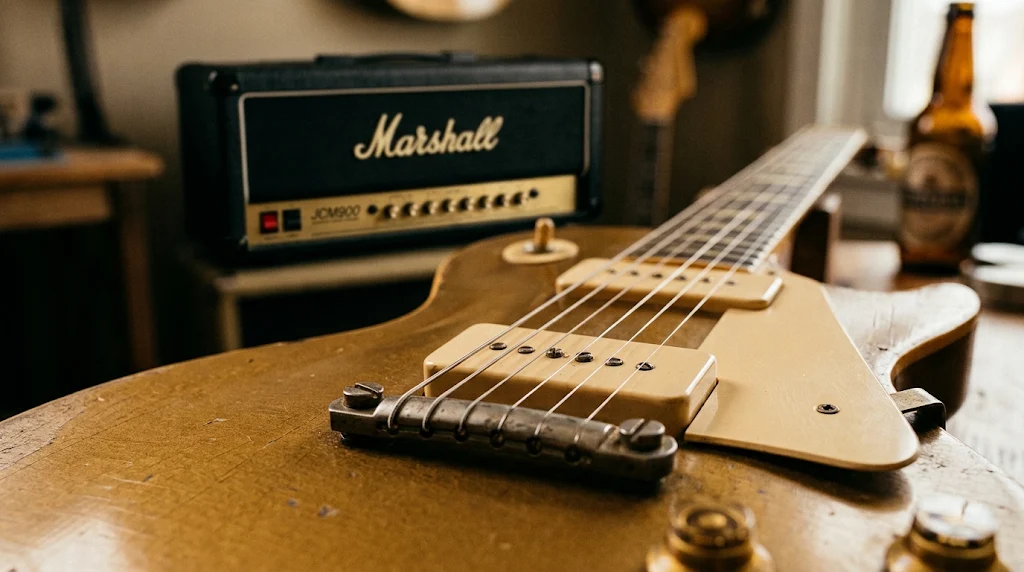
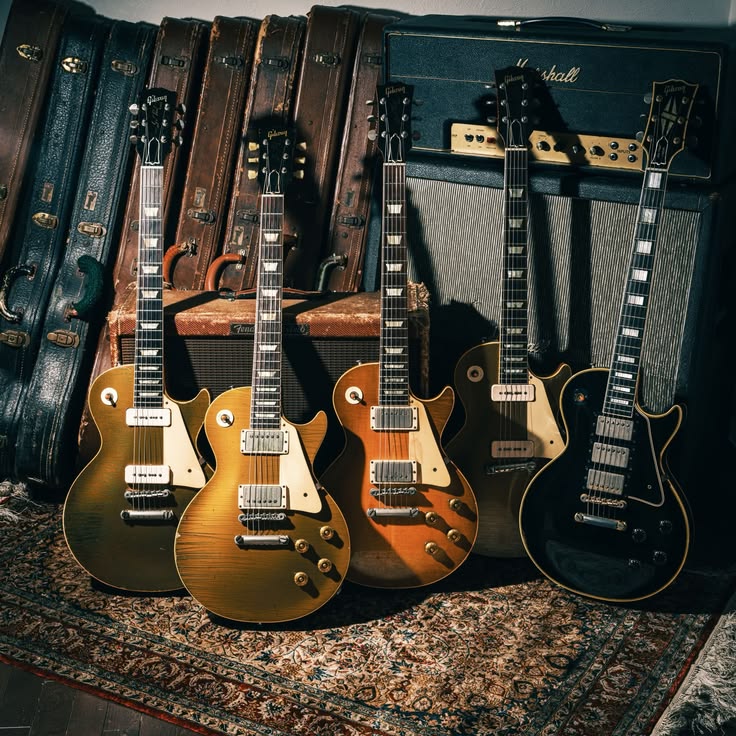
That same year, 1952, Gibson entered the solid-body electric guitar market to answer Leo Fender’s Broadcaster/Telecaster. The debut Gibson Les Paul Model—finished in metallic gold with a carved maple top and mahogany back—featured two cream-colored soapbar P-90s.
For players used to thin-sounding early solid-bodies, the 1952–1956 P-90 Goldtop was a revelation. The combination of dense mahogany, maple cap, and twin P-90s produced a thick, sustaining voice with vocal mids and crystalline clarity when rolled back on the volume pot. Blues giants like Freddie King (who famously cut “Hide Away” on a 1954 Goldtop), Hubert Sumlin, and Muddy Waters turned the P-90 Les Paul into an electric blues weapon.
The “Student” Guitars That Became Rock Icons
In 1954 and 1955, Gibson expanded the Les Paul family downward to reach beginners and working musicians on a budget:
- Les Paul Junior (1954): A slab mahogany body, sunburst finish, wraparound bridge, and a single bridge-position dog-ear P-90.
- Les Paul Special (1955): A slab mahogany body finished in TV Yellow, bound fingerboard, and two soapbar P-90s.
Gibson viewed both instruments as entry-level stepping stones. Instead, they turned out to be happy accidents of acoustic physics. Without a heavy maple cap or complex switching circuits, a single P-90 screwed directly into a slab of resonant Honduras mahogany delivered an immediate, raw, mid-forward punch that hit tube amps like a freight train. Decades later, those “student” guitars would become the first-choice weapons of punk, glam, and hard rock guitarists.
Magnet Evolution: Alnico III, Alnico V and the 1957 PAF Disruption
If you look closely at vintage P-90s made between 1946 and the early 1960s, you will discover that not every vintage P-90 was built to the exact same recipe. Like most 1950s Kalamazoo manufacturing, Gibson worked with the magnets they had on the shelf, refining the formula as metallurgy and player demands changed.
The Magnet Shift: Alnico III to Alnico V
During the late 1940s and early 1950s—including the debut 1952 Les Paul Goldtops—Gibson primarily loaded P-90s with Alnico III magnets (and occasionally thicker 3/16-inch Alnico III bars in 1952–1953 alongside the standard 1/8-inch thickness). Alnico III actually contains no cobalt; it has a lower magnetic pull and produces a sweeter, softer, slightly more compressed top end with woody, complex mids.
Around 1957, Gibson transitioned its standard P-90 specification to stronger Alnico V magnets. Alnico V tightened up the low end, increased overall output, and added extra treble bite and dynamics—giving late-’50s and ’60s P-90s that aggressive, authoritative snarl we associate with classic rock. (In between, Gibson’s parts bins also saw occasional Alnico II and Alnico IV bars, which explains why two original 1950s P-90s can sometimes feel subtly different under the fingers.)
Dethroned by the PAF—Yet Refusing to Die
1957 was also the year Seth Lover’s PAF (Patent Applied For) humbucker arrived on the Les Paul Standard, ES-175, and ES-350T. Designed specifically to solve the P-90’s biggest weakness—60-cycle mains hum under stage lighting and neon signs—the humbucker quickly replaced the P-90 on Gibson’s flagship solid-body and archtop models.
On paper, the P-90 could have vanished into history right there. Instead, Gibson kept it alive across its thinline hollow-bodies and double-cutaway solid-bodies:
- The ES-330 (1959) and Epiphone Casino (1961): When Gibson acquired Epiphone and began building Epiphone models in Kalamazoo in the late 1950s, the fully hollow ES-330 and its twin cousin, the Epiphone Casino, were fitted with dual dog-ear P-90s. In the hands of John Lennon, Paul McCartney, and George Harrison, the P-90-equipped Casino defined the sound of Revolver, Sgt. Pepper, and the Beatles’ rooftop concert.
- The SG Junior and SG Special (1961): When Gibson redesigned the Les Paul into the sleek, double-cutaway SG body shape in 1961, the Standard got humbuckers, while the SG Junior and SG Special carried the P-90 torch forward into the British Invasion and late-1960s heavy rock eras.
Why a P-90 Sounds Like a P-90 (The Tone Anatomy)
Guitarists often describe the P-90 as “a fat single coil” or “a single coil that wants to be a humbucker,” but neither description gives Walt Fuller enough credit. Sonically, a P-90 occupies its own territory.
If you compare a Fender Stratocaster pickup, a Gibson P-90, and a PAF humbucker side by side through the exact same amp—or test them back-to-back inside a Neural Amp Modeler capture like the Fender ’62 Deluxe capture we tested recently—three distinct electrical traits stand out:
- The Midrange Growl: Because the P-90 uses a wide, flat coil with 10,000 turns of wire and twin bar magnets, its resonant peak sits lower than a Strat or Tele pickup, while its midrange energy is dramatically stronger. Where a Strat scoops out at around 400–600 Hz, a P-90 pushes right through that band. In a dense band mix with loud drums and a distorted bass, a P-90 guitar never disappears.
- Uncompressed Attack and Dynamics: Humbuckers sense a wide aperture across two coils and cancel out higher frequencies through phase cancellation, resulting in a smooth, compressed, creamy response. Because a P-90 has only a single coil, every pick scrape, finger-pluck, and changes in picking velocity jumps straight out of the speaker. Roll your guitar’s volume knob down from 10 to 7, and a roaring P-90 cleans up into a glassy, chime-filled rhythm tone without losing high-end sparkle.
- The Honest 60-Cycle Hum: Let’s not sugarcoat it—a traditional P-90 is a true single-coil pickup, and with 10,000 turns of wire acting as an antenna, it will hum near fluorescent lights, dimmer switches, or noisy power supplies. (If you are running P-90s on a pedalboard, clean isolated power is non-negotiable—see our Joyo Power Supply 2 review and noise test for how budget power bricks handle single-coil noise.) On most two-pickup P-90 guitars built since the 1990s, manufacturers wind the neck and bridge pickups RWRP (Reverse Wound, Reverse Polarity) so the middle toggle position cancels hum just like positions 2 and 4 on a Stratocaster.
If you’ve ever swapped between high-output humbuckers (like the Fender Enforcer humbucker we reviewed in a Telecaster Deluxe) and a good set of P-90s, the difference in feel is immediate: high-output humbuckers push the amp smoothly, whereas a P-90 bites the front end of the preamp and dares it to break up.
Famous P-90 Moments That Changed Rock History
You don’t need to dig into obscure jazz records to hear why the P-90 refused to go obsolete. Some of the most ferocious, iconic guitar tones ever committed to tape came from single-coil soapbars and dog-ears:
- Pete Townshend (The Who – Live at Leeds, 1970): Townshend played a late-1960s Gibson SG Special loaded with two soapbar P-90s into cranked Hiwatt stacks. That explosive, percussive crunch on “Young Man Blues” and “Summertime Blues”—where huge open chords ring with piano-like clarity despite massive volume—is pure P-90 magic.
- Leslie West (Mountain – “Mississippi Queen”, 1970): Armed with a mid-1950s Les Paul Junior and a single dog-ear P-90, Leslie West proved that one single-coil pickup could sound bigger, thicker, and heavier than almost any humbucker on earth.
- Carlos Santana (Santana – Woodstock, 1969): Before his famous PRS and Yamaha humbucker years, Santana’s soaring, sustaining lead tone at Woodstock came straight from a red SG Special fitted with P-90s.
- Tony Iommi (Black Sabbath – Black Sabbath and Paranoid, 1970): Before modifying his SG with custom John Birch pickups, Iommi recorded Sabbath’s foundational doom-metal riffs on a white 1965 SG Special equipped with P-90s—proving early on that single coils could handle heavy, dark riffing.
- Johnny Thunders (New York Dolls / The Heartbreakers): Thunders’ TV Yellow Les Paul Junior became the visual and sonic emblem of 1970s punk rock—raw, spiky, unpolished, and impossible to tame.
- Mike Ness (Social Distortion) & Billie Joe Armstrong (Green Day): From Ness’s modified 1970s Goldtops to Armstrong’s heavily toured 1956 Les Paul Junior (“Floyd”), modern punk and alternative rock owe their cutting, articulate wall-of-guitars rhythm sound directly to the P-90.
- Bob Marley (“No Woman, No Cry”): Marley’s modified Les Paul Special with dual P-90s delivered the warm, percussive reggae skank that anchored his classic Wailers recordings.
Oddball Variants and Modern Evolutions
Over the last forty years, pickup winders and guitar makers have continually tweaked Walt Fuller’s 1946 blueprint to solve hum issues or fit P-90 tones into non-P-90 guitars:
1. Humbucker-Sized P-90s
Because a traditional soapbar P-90 is wider than a standard humbucker (roughly 3.36 inches long vs. 2.75 inches for a humbucker) and slightly narrower front-to-back, you cannot drop a real P-90 into a humbucker-routed guitar without routing wood. In the 1990s and 2000s, boutique winders and major brands like Seymour Duncan (with the Phat Cat) and Gibson (with the P-94) engineered true single-coil P-90 bobbins and twin bar magnets inside standard metal humbucker covers. While the slightly narrower bobbin changes the magnetic aperture a touch, they bring 90% of the authentic P-90 snarl to any Les Paul, SG, or superstrat without touching a router.
2. Noiseless and Stacked P-90s (P-100, Sidewinder, and Dual-Coil Designs)
In the early 1990s, Gibson attempted to eliminate 60-cycle hum with the P-100—a stacked humbucker hidden inside a soapbar cover. Players largely disliked it because stacking two coils vertically robbed the pickup of its open top-end bite and dynamic bounce. Modern noiseless designs—such as Seymour Duncan’s P-90 Silencer, Kinman’s P-90 Hx, and Gibson’s newer P-90 DC—use side-by-side dummy coils or specialized magnetic geometry to kill the hum while preserving the wide single-coil frequency response.
3. The P-90S and Staple-Top Variants
In 1954, Gibson introduced the Alnico V “Staple” pickup (designed by Seth Lover) for the neck position of the Les Paul Custom—a soapbar-sized single coil featuring six rectangular Alnico bar magnets instead of adjustable screws. Later still, Gibson released the P-90S, inspired by early ES-125 pickups, which replaced the twin bar magnets and screws with six non-adjustable rectangular Alnico slug pole pieces.
4. P-90s in Modern Heavy & Detuned Genres
While purists still associate P-90s with vintage blues and ’70s rock, modern players have rediscovered them for drop-tuned riffing, grunge, and stoner rock. Because a P-90 has less muddy low-end bloat than a high-output ceramic humbucker, tuned-down power chords stay tight and articulate even under heavy fuzz or octave pedals. (If you want to experiment with thick sub-octave riffing under a P-90 guitar, download our free Octaver sub-octave VST3 plugin—rolling onto a neck P-90 gives analog-style octave dividers the cleanest fundamental tracking you can get.)
And if you are writing riffs around those fat P-90 chord voicings, fire up Rootwork to map out scale and chord shapes in alternate tunings, or use Chord Pathways to test progressions that let that single-coil midrange ring out.
Eighty Years Later, Still Unbeatable
Few pieces of music technology survive eight decades without needing a complete reinvention. Since 1946, guitarists have been offered active pickups, stacked noiseless coils, piezo bridges, digital modeling, and neural amp captures—yet whenever a player wants a guitar that feels alive, cuts through a band mix without harshness, and cleans up with a twist of the volume knob, they still come back to Walt Fuller’s wide plastic bobbin and twin Alnico bars.
The P-90 isn’t polite, and it isn’t quiet. It hums when you stand too close to a neon beer sign, it barks when you dig in with a heavy pick, and it refuses to hide sloppy playing. That honesty is exactly why, eighty years on, nothing else sounds quite like it.
Want to hear P-90s pushed through heavy riffs, Drop D tunings, and Neural Amp Modeler rigs? Subscribe to the Beer & Guitars YouTube channel and explore more gear breakdowns in our Guides, Reviews, and NAM Captures sections.
Watch Why P90 Pickups Sound Massive in Drop D to hear how P-90s balance low-end grit and midrange clarity when tuned down.